Progress
10-minute read
≈ 3 coffee sips
If you have ever stared at a blank caption box and thought "this doesn''t sound like me," you don''t have a writing problem. You have a brand voice problem — and almost every small business has one, whether they know it or not.
A brand voice guide is the document that decides, in advance, what your business sounds like. Not what it sells. Not what it looks like. What it sounds like — in an email, in a sales page, in a refund reply, in a 30-second reel. Done well, it''s the single highest-leverage marketing document you can write, because it sits underneath everything else: your website, your launches, your newsletter, your customer service replies, and increasingly, the prompts you feed ChatGPT, Claude, and every other AI tool that drafts copy on your behalf.
In this guide, I''ll walk you through exactly how to write a brand voice guide that''s short enough to actually use, specific enough to actually work, and structured so your future self (or a contractor, or an AI) can write as the brand without you having to rewrite every line.
Why most brand voice guides fail
Walk into any agency and you''ll find brand voice guides that read like academic essays. Twenty pages of adjectives. "Confident, but approachable. Bold, but kind. Witty, but never sarcastic." The team nods, files it in a Notion page, and the next caption sounds exactly like the last twelve.
The problem isn''t that those guides are wrong. It''s that they''re unusable. A voice guide that only describes the voice can''t produce the voice. It''s the difference between describing a recipe and writing one. "Comforting, warm, slightly sweet" doesn''t make a loaf of bread. Flour, water, salt, yeast, 220°C for 35 minutes — that makes bread.
The second reason most guides fail: they''re written for designers and copywriters who already understand voice. In 2026, your voice guide also has to be readable by an AI model that has never met you. That means examples, not adjectives. Rules, not vibes. Side-by-side rewrites — "we say this, not that" — so the model has a pattern to imitate.

The four pillars of a usable brand voice guide
After helping dozens of founders rewrite their voice guides — and rewriting my own about six times — I''ve landed on a four-pillar structure I call the Voice Scaffold. Every section produces something a writer (human or AI) can act on.
Pillar 1 — The Promise
One sentence: what the brand promises the reader, every time they hear from us. Not the marketing tagline. The internal promise. Mine is: "You will leave every email, post or product feeling more capable, not more confused."
This sentence is the filter. If a draft doesn''t honour the promise, it gets rewritten before it ships. It also doubles as the test for tone — if a sentence would make the reader feel less capable (jargon, condescension, hype), it''s off-voice by definition.
Pillar 2 — The Voice Triangle
Pick exactly three adjectives. Not eight. Three.
For each adjective, write:
- What it means in practice (one sentence)
- What it''s NOT (one sentence — this is where vague guides die)
- Two example phrases that demonstrate it
Mine, for Shop the Evolution, looks like this:
Calm. We don''t write in exclamation marks or urgency. NOT monotone or cold — calm means measured, not flat. Example phrases: "When you''re ready." "There''s no rush on this." "Take the version that fits your week."
Specific. We name the thing, the price, the exact next step. NOT clever or oblique — specificity beats cleverness every time. Example phrases: "$27, 17 pages, instant download." "Three priorities a week. Not four."
Honest. We say the quiet part out loud — the pricing flinch, the launch that flopped, the version we abandoned. NOT oversharing or confessional — honesty is editorial, not therapeutic. Example phrases: "I almost killed this offer." "The first launch was a rehearsal, not a launch."
Three is the magic number. Two leaves room for drift. Four invites contradiction. Three forces a choice.
Adjectives describe the voice. Examples produce the voice. If you only have time for one, choose examples.
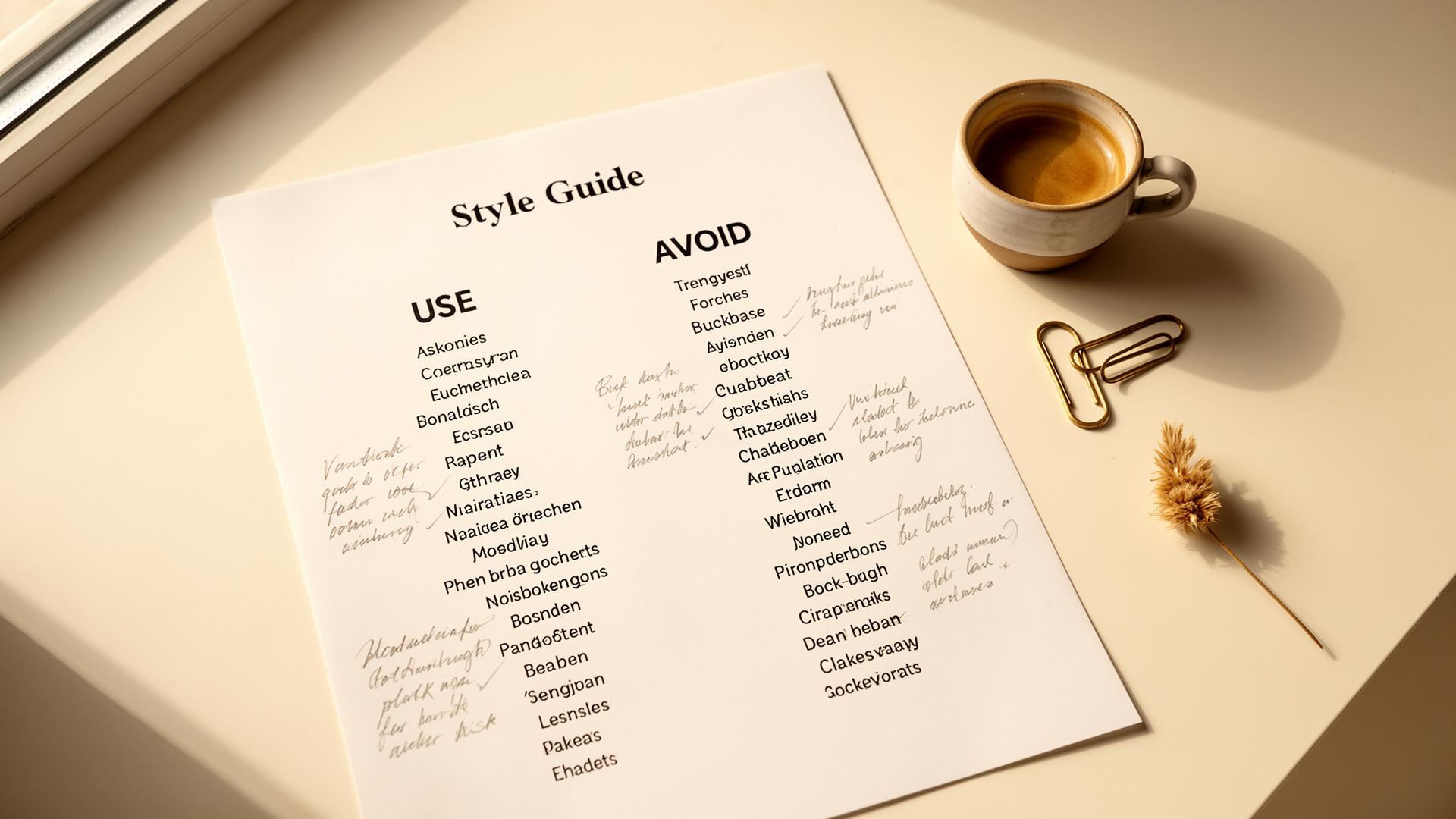
Pillar 3 — The Word Bank
Two columns. Words we use. Words we don''t. No explanation needed — the columns are the explanation.
USE                          AVOID
when you''re ready            act now / don''t miss out
build                        hustle / grind
the version of you           your best self / your highest self
inside / get the…            unlock / discover the secret
honest pricing               affordable / cheap
season                       phase / era
This is the section your AI will actually use. When you prompt a model with "write a launch email in our voice," the word bank is what stops it sounding like every other launch email on the internet. Aim for 15–25 entries on each side, and refresh quarterly as the brand evolves.
Pillar 4 — The Rewrites
This is the section everyone skips and the section that does the most work.
Take 8–12 sentences your brand has actually written badly (or that a competitor writes badly) and rewrite them in-voice. Show the before. Show the after. One line of reasoning underneath.
Before: "Don''t miss out on this incredible limited-time offer!" After: "The price goes up Friday. Inside, it''s 17 pages of positioning exercises." Why: Calm replaces urgency. Specific replaces hype. Honest replaces FOMO.
Eight of these is worth more than twenty pages of theory. It''s the section a contractor reads first, the section you''ll paste into every AI prompt, and the section that, six months from now, will quietly fix the off-brand caption you didn''t notice you were about to publish.
A brand voice guide isn''t finished when it''s comprehensive. It''s finished when a stranger can write your next email and you''d sign your name to it.
Examples from brands that get it right
A few public-facing voice patterns worth studying — not to copy, but to notice how consistent the cadence is across every touchpoint.
Mailchimp writes with a friendly, peer-to-peer cadence that never tips into cute. Their voice guide (publicly available at styleguide.mailchimp.com) is the gold standard for the four-pillar structure — every rule has an example, every example has a rewrite, and the entire document is searchable.
Notion uses short, declarative sentences and product-led language ("a new home for…") rather than feature lists. You can predict the next sentence of a Notion email after reading three.
Glossier, even now, writes with the "text from a friend" cadence that built the brand. The voice doesn''t change between an Instagram caption and a refund email — that''s the test of a real voice guide.
You don''t need to be a billion-dollar brand to be that consistent. You need a four-page document, written once, refreshed quarterly, and actually used.

Common mistakes founders make
After reading hundreds of voice guides, the same six mistakes show up every time:
- Too many adjectives. Three is the limit. Eight is a personality crisis.
- No "NOT" definitions. "Bold" without "not arrogant" is a coin flip every time someone writes a sentence.
- No word bank. Adjectives don''t scale; vocabulary does. The word bank is what makes the guide usable by AI tools.
- No rewrites. Theory without examples is unenforceable. If you skip Pillar 4, the guide will quietly stop being used within a month.
- Written for designers, not writers. A voice guide is a writing document. Visual brand guidelines are a separate file.
- Never updated. Voice evolves as the brand grows. Put a 90-day calendar reminder on the doc — review it the day before every quarterly planning session.
The biggest mistake, though, is treating the guide as a deliverable rather than a system. A voice guide that sits in a folder is decoration. A voice guide that lives at the top of every Google Doc, every Notion brief, and every AI prompt is infrastructure.
Resources to deepen the work
A short, opinionated reading list:
- Building a StoryBrand by Donald Miller — the clearest book on customer-facing language. Skip the framework worship, keep the principles.
- Everybody Writes by Ann Handley — the only writing book most founders actually need. Chapter 12 (on "voice") is worth the price of the whole book.
- Mailchimp Content Style Guide (free, online) — the template every founder should reverse-engineer before writing their own.
- The Brand Voice Prompt Pack (ours) — 100 modular prompts and the full Voice Scaffold as a fillable template, built specifically for founders who use AI tools to draft first drafts.
- Grammarly''s Brand Tones feature — useful as a sanity check once your voice is defined; don''t use it to define the voice.
If you only do one thing from this list, copy the Mailchimp guide''s structure (sections, headings, length) and write your own four-pillar version. Two afternoons of work, ten years of returns.

Your seven-step action plan
Here''s the workflow I''d run if I were writing a voice guide from scratch this week:
- Block four hours. Two in the morning, two the next morning. Voice work is deep work — it doesn''t survive being squeezed between calls.
- Write The Promise first. One sentence. Rewrite it ten times before you settle.
- Pick three adjectives. For each, write the "means / NOT / examples" block. Force yourself to stop at three.
- Build the word bank. Skim your last 20 emails, captions and product pages. Pull every word you''d defend; pull every word that makes you cringe. Two columns. 15–25 entries each.
- Write eight rewrites. Take real sentences — yours or a competitor''s — and rewrite them in-voice. Add a one-line "why" under each.
- Run the stranger test. Send the doc to one trusted person who doesn''t work in your business. Ask them to write one caption and one refund email using only the doc. If they can, the doc works.
- Set a quarterly review. Calendar reminder. 30 minutes. Update the word bank, refresh two rewrites, retire any rule that hasn''t earned its keep.
That''s the whole system. Four hours of work, one stranger test, one recurring calendar event — and your brand will sound like itself across every email, every launch, and every AI-drafted first pass for the next twelve months.
The bottom line
Your brand voice isn''t a vibe. It''s a document. And the document only works if it''s short, specific, and full of examples a stranger could imitate without ever meeting you.
Write the guide. Use the guide. Refresh the guide quarterly. That''s the entire job — and it''s the one marketing investment that compounds quietly in the background of every other thing you ship.
Frequently asked
Q: How is a brand voice guide different from a style guide? A: A style guide covers mechanics — punctuation, capitalisation, oxford commas, em-dash vs en-dash. A voice guide covers character — what the brand sounds like emotionally and editorially. You need both, but they''re separate documents.
Q: Can I use ChatGPT to write my brand voice guide? A: Use it as a sparring partner, not an author. Paste in 10 of your best-written sentences and ask the model to reverse-engineer three adjectives. Paste in 10 sentences you''d never publish and ask it to extract the "NOT" list. Then write the actual guide yourself — the document has to come from a human who knows the brand''s history.
Q: How often should I update my brand voice guide? A: Quarterly is the rhythm that works for most founders. Put a 30-minute review on the calendar the day before each quarterly planning session. Update the word bank, refresh two rewrites, and retire any rule you haven''t enforced in 90 days.
Q: What''s the difference between brand voice and brand tone? A: Voice is constant — it''s how the brand always sounds. Tone shifts with context — celebratory in a launch email, careful in a refund reply, warm in a welcome sequence. Voice is the instrument; tone is the song. A good guide defines the voice and gives 2–3 examples of how the tone flexes across common scenarios.
Q: Do I need a brand voice guide if I''m a solopreneur? A: Especially if you''re a solopreneur. Solopreneurs hand work to contractors, virtual assistants, and AI tools every week. Without a voice guide, every handoff produces drift. With one, the brand sounds like you even when you''re not the one writing.
Q: How do I get my team to actually use the voice guide? A: Pin it to the top of every shared writing template. Paste the word bank into every AI prompt. Add a "voice check" line to your publishing checklist. The guide isn''t used because it''s written — it''s used because it''s placed where the writing actually happens.
Marketing in Motion
Marketing playbooks that don't burn you out.
Weekly campaign breakdowns, copy patterns and launch frameworks.
Some links may be affiliate. Disclosure.
Follow Evolve with Kiea
Save this for later · Pin the resource
Continue learning. Continue building.
Continue creating. Continue evolving.
— Evolution Press®